Winterizer Fertilizer in Central Oregon: A Complete Guide to the Year's Last Feeding
The November feeding is the one that decides what April looks like. Timing, nitrogen rates, when fall rates double, and why the bag matters less than the date.
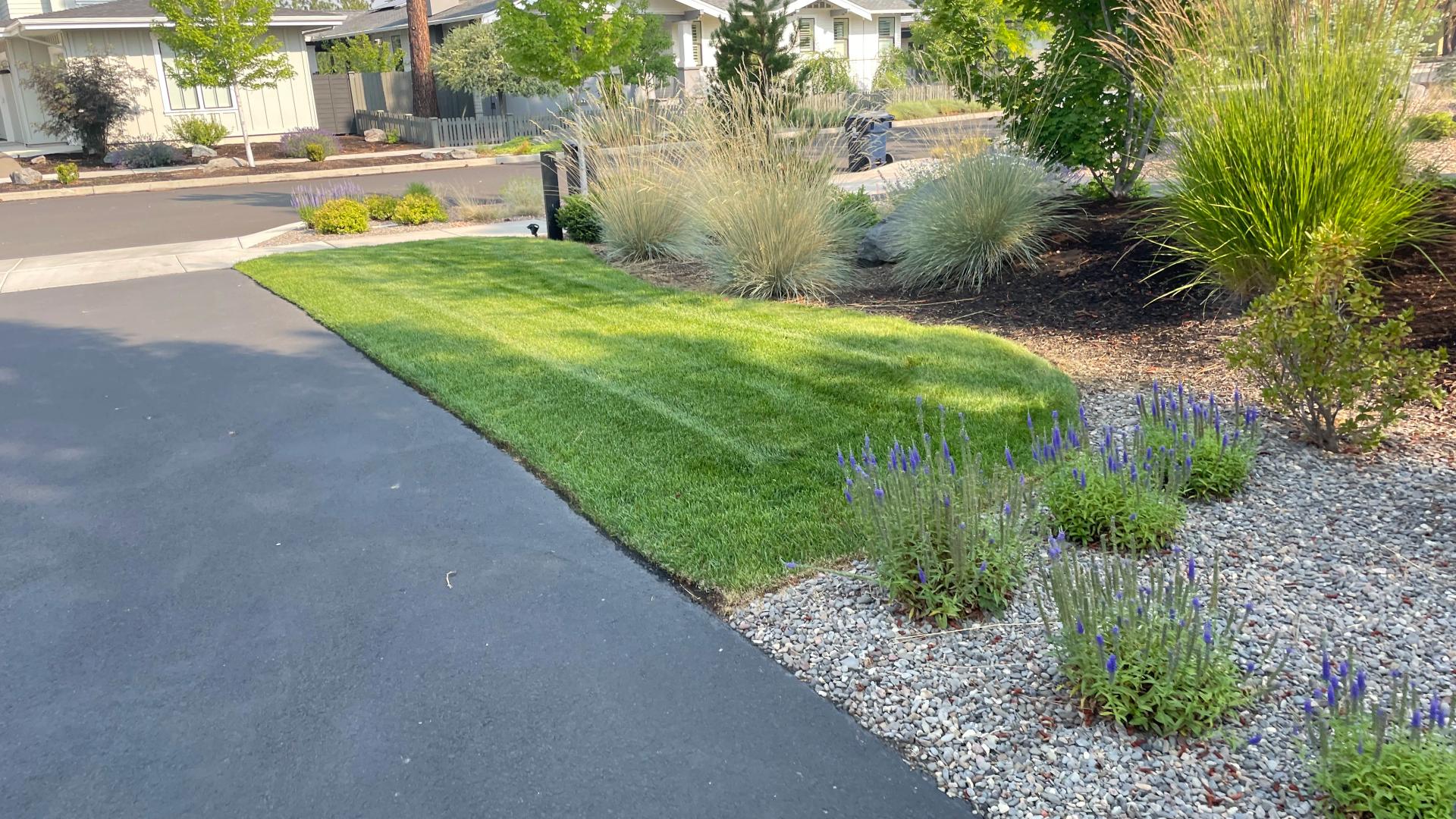
Winterizer fertilizer in Bend, Oregon goes down between mid November and early December, weeks after most homeowners have stopped thinking about the lawn. It is also the application that does the most for how the turf looks the following April. By November the grass has stopped growing vertically but the roots are still active in soil that has not frozen, which is the exact condition that makes this feeding work. Here is the complete picture.
What the Last Feeding Actually Does
Nitrogen applied in May or June goes into leaf growth. Nitrogen applied in mid November goes somewhere else. Top growth has already slowed or stopped in response to short days and cold nights, so the plant routes what it takes up into root development and into carbohydrate storage in the crown.
That stored energy is what the lawn spends in early spring. A turf stand that went into winter with full reserves greens up earlier, recovers from snow damage faster, and closes its canopy before weed seed gets a foothold. A stand that went into winter empty spends April borrowing against itself. This is why a lawn can look identical to its neighbor in October and noticeably better in April.
The Central Oregon Window
Our fertilizer calendar for Bend runs three applications: May, June to early July, and mid November to early December. There is also an optional September to October application on lawns that want it.
The mid November to early December window is specific to this climate. You want the soil still workable and the roots still functioning, but top growth finished. Apply too early, in late September on a warm fall, and you push a flush of tender growth that then takes a frost. Bend's first fall frost risk begins around September 3 and the 50 percent date is around September 20, so by mid November that risk is long past and the plant is in the right physiological state. Apply too late, into a frozen or snow covered lawn, and the product sits on the surface where it can move off site with melt instead of into the root zone.
Rate: One Pound of Nitrogen, and When It Doubles
The working rate is one pound of actual nitrogen per 1,000 square feet per application. That is a rate of nitrogen, not a rate of product, and the difference trips up most homeowners buying a bag. A 21 percent nitrogen product requires roughly 4.8 pounds of product to deliver one pound of nitrogen over 1,000 square feet.
Fall applications may be doubled, up to two pounds of nitrogen per 1,000 square feet, on lawns that will use it. That decision depends on the stand: species, age, how hard the summer ran it, and whether a September application already went down. Doubling a fall rate on a thin, shaded, shallow rooted lawn is not a favor. This is the kind of call that should be made on the property, and it is the same reasoning behind our September fertilizer guide.
Why Timing Beats Product Selection
Homeowners spend an hour in the aisle comparing bags. The bag matters far less than the date. A mid grade fertilizer applied in the correct window on soil that can still move it outperforms a premium blend applied three weeks late.
The second thing that beats product is uniformity. Streaked application shows up in the spring as green stripes against pale ones, and the stripes last until the June feeding evens them out. Consistent spreader overlap on a windy Central Oregon afternoon is harder than it looks, which is a large part of why this job goes to a crew. Our fall fertilizer tips post covers the application mistakes we see most often.
Watering It In, and What Happens If You Cannot
Fertilizer needs moisture to move from the surface into the root zone. In mid November your irrigation system has been blown out since the first three weeks of October and is not coming back until spring, so you are relying on precipitation.
In practice that works in Central Oregon, because the November and December pattern reliably provides moisture and irrigation demand for those months is effectively zero. If you are applying into a dry stretch, a hose and a sprinkler for a short cycle on a day above freezing will do it, then drain and disconnect. Do not leave a hose attached to a hose bib overnight in November.
Winterizer on a Tetherow Property
Tetherow lawns are small by design. The community is built around drought tolerant and native plantings with more drip zones than turf, significant grade, and native rock throughout. That changes the job in two ways.
First, the turf areas are small enough that a spreader pass can overshoot into native and drip planted areas where fertilizer is unwanted, so edge control matters. Second, grade moves product. On a sloped turf panel, uniform application at the top and a heavy band at the bottom is what you get if the applicator is not adjusting. Many Tetherow homes are second homes with absentee owners, which means nobody is there in mid November to notice the lawn was skipped. On a recurring agreement it simply happens, and our winter lawn care guide covers what else gets done on those visits.
Three Applications, One Flat Rate
Three fertilizer applications per year are part of recurring maintenance at Edge and are covered by your flat monthly rate. The November feeding is not an add on, not a seasonal package, and not a line item that appears on a winter invoice. Pricing is on our services page.
"My yard looks like a golf course. I cannot say enough. Edge is the best!"
Jerry K., Google review
Get the Last Feeding Done
Call Edge Landscaping at (541) 526-0922 before the window closes. We serve Bend and Redmond, including NorthWest Crossing, Discovery West, Tree Farm, Tetherow, Broken Top and Awbrey Butte.
Edge Landscaping is licensed, bonded and insured in Oregon, LCB #100442.