9 Things Included in an Edge Fall Clean-Up in Bend
Most fall clean-up quotes in Bend say "fall clean-up" and nothing else. Here are the nine jobs that phrase should cover, and what Awbrey Butte slopes add.
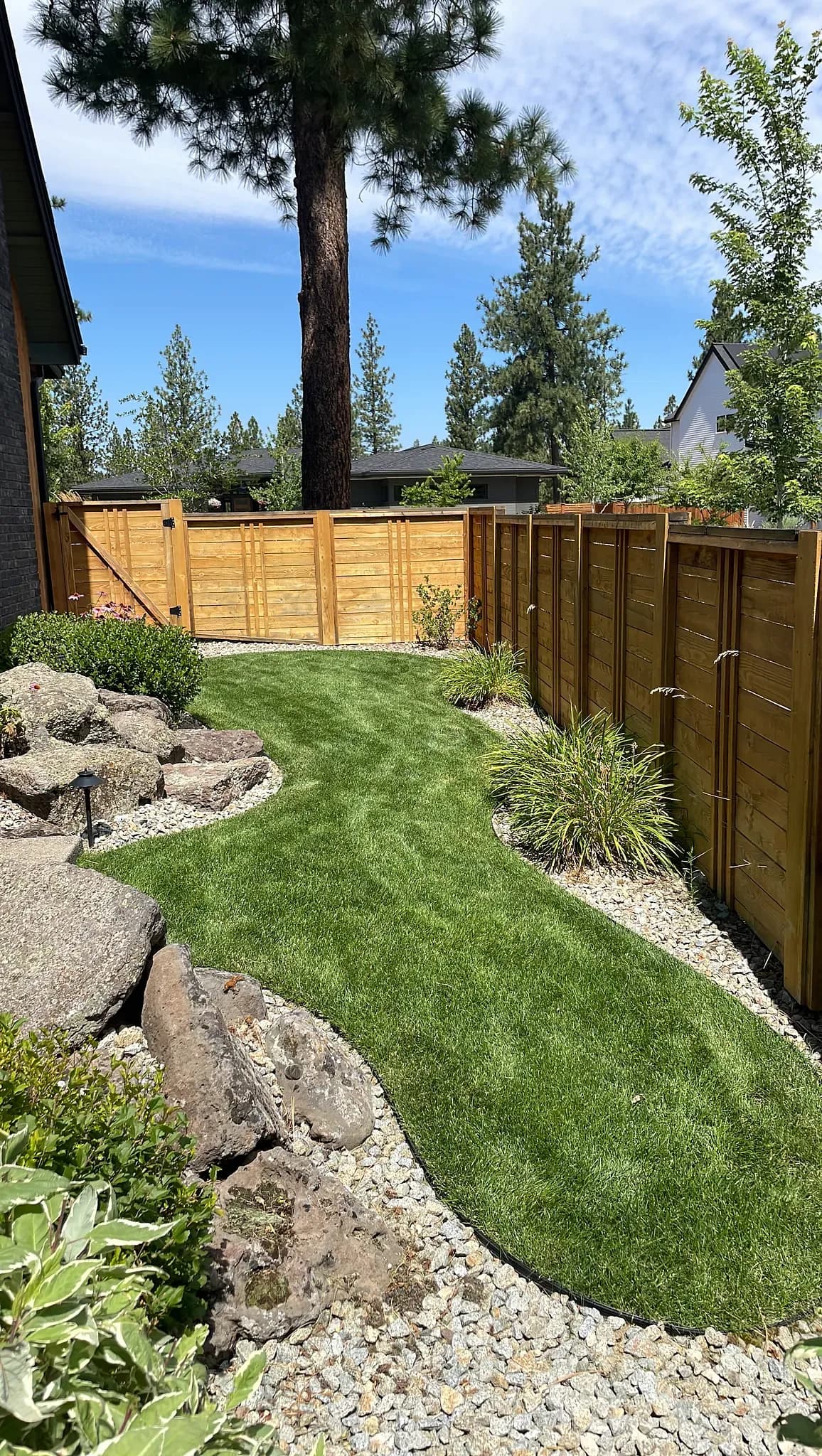
"Fall clean-up" is one of the vaguest line items in the landscaping business. Two companies can quote the same property, hundreds of dollars apart, and both be describing something they would honestly call a fall clean-up.
So here is ours, broken into the nine jobs it actually contains. If you are comparing quotes this October, this list is a useful yardstick regardless of who you hire.
1. Leaf and needle removal across the entire property
Not just the turf. A fall clean-up that stops at the lawn edge leaves the majority of the debris exactly where it will cause problems, which is in the beds, along fence lines, and packed against the foundation.
In Bend this matters more than in most places because ponderosa needles do not blow away the way deciduous leaves do. They mat, they interlock, and they hold moisture against whatever is underneath them all winter.
2. Rock bed and gravel debris extraction
This is the job that separates a real clean-up from a fast one, and it is the most labor-intensive item on this list.
Central Oregon landscapes are full of rock. Needles and leaves fall into it and settle down between the stones where a blower cannot reach them without scattering the rock. Done properly, this is hand work and specialized raking. Done improperly, it is skipped, and next spring you have a layer of decomposing organic matter under your gravel that grows weeds all season.
3. Perennial cut-back and ornamental grass trimming
Perennials get cut back to the right height for the species, not uniformly scalped. Ornamental grasses get evaluated individually, because some hold up beautifully under snow and provide winter structure while others collapse into a wet mat that smothers whatever is beneath them.
4. Final structural pruning of shrubs and ornamentals
Late fall pruning is about structure and snow load, not shaping. The goal is to remove the weak, crossing, and overextended growth that will split when wet snow lands on it in November.
This is judgment work. Prune too aggressively in fall and you stimulate tender growth going into a freeze. The pruning that shapes a plant happens in late winter, not now.
5. Bed edge redefinition
Every bed edge gets cut back to a clean line before winter. Partly this is appearance, and it is the single thing that makes a property look maintained from the street through five months of brown dormancy.
The functional reason is better: a defined edge stops turf from creeping into beds over the winter and spring, which means less corrective work and less herbicide in April.
6. Final mow at the correct height
The last mow of the season is a specific decision, not just the last time somebody happened to run a mower.
Too tall going into winter and the grass mats under snow, which is how you get snow mold. Too short and you have stressed the plant right before its hardest season and removed the insulation the crown needs. The target is the low end of the normal range, cut after growth has effectively stopped but before the ground freezes.
7. Hardscape blowing, including driveway and walkways
Every hard surface gets cleared: patios, walkways, the driveway, and the areas around downspouts. Debris left on pavers holds water, and water on pavers in Bend in November means ice by morning.
On Awbrey Butte this is a safety item rather than a cosmetic one, which brings us to the part of this list that is specific to the neighborhood.
8. Drainage paths and downspout outfalls cleared
Awbrey Butte is built on grade. Properties there have slopes, rock outcroppings, and drainage that was engineered to move water down and away from the structure during snowmelt.
Every one of those paths collects leaves and needles over the fall. A blocked outfall or a packed swale means meltwater goes somewhere it was not designed to go, usually toward a foundation or across a driveway where it refreezes. On a flat lot this is minor housekeeping. On the Butte it is the difference between an uneventful February and a problem.
The mature junipers and established landscapes that make Awbrey Butte properties beautiful also generate real volume. A half-acre lot up there produces several times the debris of a comparable lot on the east side, and the grade means all of it migrates downhill into exactly the places you need clear.
9. All debris hauled off the property
Everything leaves. No piles behind the shed, no bags at the curb waiting for you to deal with, no green waste run on your Saturday.
This one sounds obvious and it is worth checking in any quote you receive, because haul-off is a common exclusion and it is a meaningful cost.
What is not in a fall clean-up
Worth being straight about this. Dethatching, aeration and overseeding are not part of a fall clean-up and they are not annual services. At Edge those are provided free every third season, because that is the interval at which a Bend lawn actually benefits from them. Anyone selling you aeration every single year is selling you something your lawn did not ask for.
Your irrigation blow-out is also its own service on its own schedule, typically running earlier in October than clean-ups.
It is included, not invoiced
For clients on a recurring maintenance agreement, the fall clean-up is included. So is the spring clean-up. Most Bend companies quote these separately in the several-hundred-dollar range each, which means every October you get a phone call asking whether you want to spend the money this year.
Flat monthly pricing removes that decision. The fall fertilizer applications, the clean-up, and the blow-out are all already paid for, scheduled, and on the route. Edge Landscaping is licensed, bonded and insured, Oregon LCB #100442, and we have not missed a scheduled job since we opened in 2020.
"Jared and his team are very professional and do great work. They did a large fall cleanup for us and they were able to complete the job in a few hours."
Barbara G., Google review
Get on the October schedule
Call Edge Landscaping at (541) 526-0922 or request a quote through our site. We serve Bend and Redmond, including Awbrey Butte, NorthWest Crossing, Discovery West, Tetherow, Broken Top and Tree Farm.